What Digital Marketing Services Do Australian Businesses Need the Most?
Explore the most important digital marketing services Australian businesses need in 2026, from SEO and Google Ads to content marketing, social media, and local SEO, and learn how to choose the right mix for your business goals.
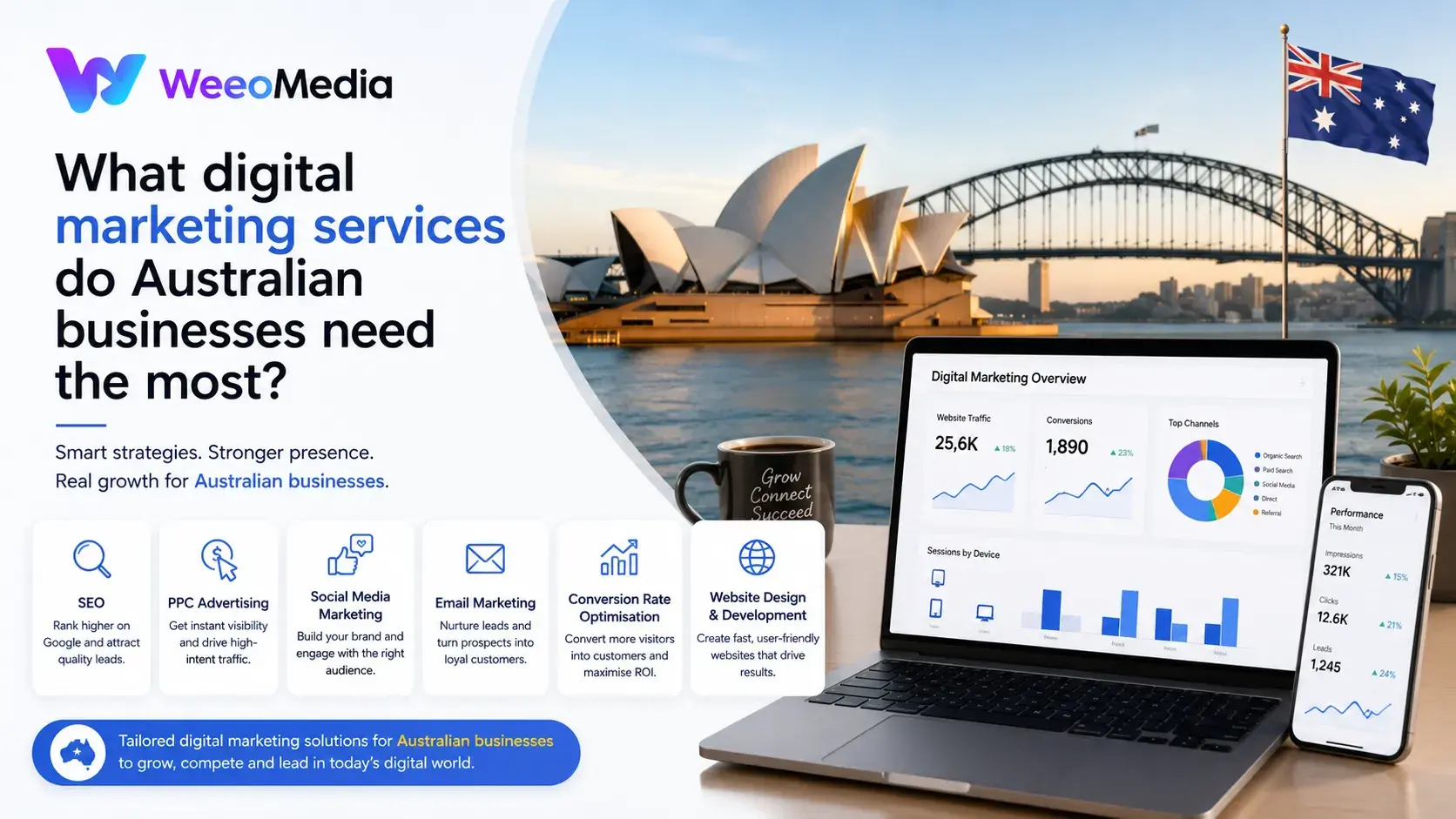
Australia's business landscape is evolving faster than ever before. From small family-owned shops in regional Queensland to fast-growing e-commerce startups in Sydney and established professional services firms in Melbourne, every type of Australian business is competing for attention in an increasingly crowded digital environment. The question most business owners are asking is no longer whether they need digital marketing, it is which digital marketing services will deliver the most value for their specific situation.
The answer is not the same for every business. A local cafe in Brisbane has very different digital marketing needs compared to a national retail brand or a B2B software company. However, certain services consistently deliver the strongest return across the widest range of Australian businesses, regardless of size, industry, or target audience.
This blog breaks down the most in-demand and highest-impact digital marketing services for Australian businesses, explaining what each one does, why it matters, and which types of businesses benefit most from each service.
The Australian Digital Landscape in 2026
Before identifying which services matter most, it helps to understand the digital environment Australian businesses are operating in. Australia has one of the highest internet penetration rates in the world, with more than 90 percent of the population actively online. Smartphone usage is near-universal, and Australians spend a significant portion of their daily lives on search engines, social media platforms, video streaming services, and e-commerce websites.
Google dominates search in Australia with well over 90 percent market share. Facebook and Instagram remain the most widely used social platforms for consumer engagement, while LinkedIn is the dominant platform for B2B marketing and professional networking. YouTube is the second largest search engine in Australia and is increasingly used by consumers to research products, services, and experiences before making a purchase decision.
This digital-first behaviour means that for most Australian businesses, the majority of their potential customers are spending significant time online every day. The businesses that succeed are those that show up consistently, in the right places, with the right message, at the right moment in the customer's decision journey.
Search Engine Optimisation
Search Engine Optimisation, or SEO, is consistently the most requested and most impactful digital marketing service in Australia across nearly every industry. SEO is the process of optimising your website and its content so that it ranks higher in Google's organic search results for keywords relevant to your business.
The reason SEO is so highly valued is straightforward. When a potential customer searches for a product or service you offer, appearing on the first page of Google results puts your business directly in front of someone who has already expressed a need. Unlike advertising, which interrupts people who may or may not be interested, organic search captures demand that already exists.
For Australian businesses, the compounding nature of SEO is particularly attractive. A well-executed SEO strategy builds rankings, authority, and traffic that continue to grow over time without a proportional increase in cost. Businesses that invest consistently in SEO typically reduce their dependence on paid advertising and enjoy a lower cost per customer acquisition as organic rankings strengthen.
SEO for small businesses in Australia is especially powerful because it levels the playing field. A well-optimised local business website can outrank much larger competitors for location-specific searches, capturing customers in their immediate geographic market without needing the advertising budget of a national brand.
Key components of effective SEO for Australian businesses include keyword research and strategy, on-page content optimisation, technical SEO improvements, local SEO and Google Business Profile management, and link building from authoritative Australian websites.
Google Ads and Pay-Per-Click Advertising
While SEO builds long-term organic visibility, Google Ads management for Australian businesses delivers immediate placement at the top of search results for high-intent queries. Google Ads operates on a Pay-Per-Click model, meaning businesses pay only when someone clicks on their advertisement.
For businesses that need immediate visibility, are launching new products or services, or operate in highly competitive markets where organic rankings take time to build, Google Ads is an essential tool. It allows businesses to appear above organic results for their target keywords almost instantly, driving qualified traffic to their website from the moment a campaign is activated.
Google Ads is particularly effective for businesses with high average transaction values, clear booking or purchase intent from their target audience, and seasonal peaks in demand. Tourism operators, legal firms, healthcare providers, real estate agencies, and e-commerce retailers are among the Australian business categories that consistently achieve strong returns from well-managed Google Ads campaigns.
The platform also offers remarketing capabilities, allowing businesses to re-engage website visitors who did not convert on their first visit. Given that most customers require multiple touchpoints before making a purchase decision, remarketing is a highly cost-effective way to stay visible throughout the consideration period.
Social Media Marketing
Social media marketing is one of the most widely adopted online marketing strategies for Australian businesses, and for good reason. Australia has exceptionally high social media engagement rates, with millions of Australians active on Facebook, Instagram, LinkedIn, TikTok, and YouTube every day.
For consumer-facing businesses, social media provides a direct channel to build brand awareness, engage with existing customers, and attract new audiences through both organic content and paid advertising. Instagram and Facebook are particularly effective for businesses in visually rich categories like food, fashion, travel, home and lifestyle, and fitness. TikTok has rapidly grown as a platform for reaching younger Australian consumers, while LinkedIn remains the most effective channel for B2B brands targeting professional and corporate audiences.
Social media marketing for Australian businesses encompasses several distinct activities. Organic social media management involves creating and publishing content that builds brand personality, engages followers, and grows an audience over time. Paid social advertising, particularly through Facebook and Instagram Ads, allows businesses to target highly specific audience segments based on demographics, interests, behaviours, and geographic location, delivering measurable results at a controllable cost.
The businesses that perform best on social media in Australia are those that invest in consistent, high-quality content that genuinely reflects their brand values and speaks to the specific interests of their target audience, rather than using social media as a broadcast channel for promotional messages alone.
Content Marketing
Content marketing is the strategic creation and distribution of valuable, relevant content that attracts and retains a clearly defined audience, ultimately driving profitable customer action. It is one of the most powerful yet frequently underestimated content marketing services for Australian companies.
In practical terms, content marketing includes blog posts and articles, destination and buying guides, video content, infographics, case studies, white papers, email newsletters, and podcasts. Each piece of content serves a specific purpose within the customer journey, attracting new audiences through search, educating prospects during the consideration phase, and building trust that converts interested visitors into paying customers.
For Australian businesses, content marketing works powerfully in combination with SEO. Every piece of well-optimised content you publish is an additional entry point into your website from Google search. A business that publishes a steady stream of high-quality, keyword-targeted blog posts builds organic search visibility across a broad range of queries over time, attracting potential customers at every stage of their decision journey.
Content marketing is particularly effective for businesses with longer sales cycles, complex products or services that require education before purchase, or strong communities of interest around their brand. Professional services firms, healthcare providers, financial advisers, travel companies, and education providers all benefit enormously from a consistent content marketing approach.
Email Marketing
Despite being one of the oldest channels in digital marketing, email marketing consistently delivers among the highest returns on investment of any digital marketing channel in Australia. For businesses with an existing customer base or a growing subscriber list, email marketing provides a direct, owned communication channel that is not subject to the algorithm changes and platform policy shifts that affect social media and search.
Email marketing for Australian businesses encompasses a range of activities, from automated welcome sequences and abandoned cart emails for e-commerce businesses, to regular newsletters, promotional campaigns, event invitations, and re-engagement sequences for dormant customers.
The most effective email marketing programs are personalised and segmented, delivering different messages to different subscriber groups based on their purchase history, interests, location, and engagement behaviour. A hotel group in Australia might send one email to past guests who visited for leisure with a summer holiday offer, and a completely different email to guests who booked corporate rates with a conference package promotion. This level of personalisation drives significantly higher open rates, click rates, and conversion rates than generic broadcast emails.
For businesses that have not yet built a subscriber list, growing one through lead magnets, content upgrades, and gated resources is one of the most valuable long-term investments in their digital marketing infrastructure.
Website Design and Conversion Rate Optimisation
Every digital marketing channel, whether SEO, Google Ads, social media, or email, ultimately directs potential customers to your website. If your website is slow, poorly designed, confusing to navigate, or fails to communicate your value proposition clearly, all of the traffic those channels generate will be wasted. This is why professional website design and CRO services in Australia are a foundational requirement for any business investing seriously in digital marketing.
Website design for digital marketing effectiveness goes beyond visual aesthetics. It encompasses site speed and Core Web Vitals performance, mobile responsiveness and usability, clear navigation and information architecture, compelling calls to action and conversion pathways, trust signals including reviews, certifications, and case studies, and seamless integration with booking, enquiry, or e-commerce systems.
Conversion Rate Optimisation, commonly known as CRO, is the ongoing process of improving the percentage of website visitors who take a desired action, whether that is making a purchase, submitting an enquiry form, booking a service, or calling your business. CRO uses data from analytics tools, heatmaps, session recordings, and A/B testing to identify where visitors are dropping off and why, then implements changes that systematically improve conversion rates.
For businesses investing significant budgets in paid advertising or SEO, even a small improvement in conversion rate can have a dramatic impact on the overall return from those investments. A business that drives 1000 visitors per month to a page that converts at 2 percent generates 20 leads. Improving that conversion rate to 4 percent doubles the leads from the same traffic volume without spending an additional dollar on acquisition.
Local SEO and Google Business Profile Management
For the significant majority of Australian businesses that serve customers in a specific geographic area, local SEO services in Australia represent one of the highest-return digital marketing investments available. Local SEO focuses on improving a business's visibility in location-based searches, particularly in Google Maps and the local pack results that appear prominently at the top of search results for queries with geographic intent.
When someone in Adelaide searches "electrician near me," or a tourist in Hobart searches "best seafood restaurant," Google uses local SEO signals to determine which businesses appear in the map results. These signals include the completeness and accuracy of your Google Business Profile, the consistency of your business name, address, and phone number across online directories, the volume and quality of your Google reviews, and the relevance of your website content to local search queries.
Local SEO delivers particularly high-quality traffic because users performing local searches typically have strong immediate intent. They are not researching in a general sense, they are looking for a business they can contact or visit right now. Appearing prominently in local search results for these high-intent queries drives calls, website visits, and foot traffic directly.
Businesses across virtually every local service category, including healthcare, legal, trades, hospitality, retail, fitness, and education, benefit enormously from a well-managed local SEO strategy.
Video Marketing and YouTube Advertising
Video has become the dominant content format across the internet, and Australian consumers are among the most engaged video audiences in the world. Video marketing for Australian businesses spans several channels and objectives, from brand awareness and product demonstration through to direct response advertising and customer testimonials.
YouTube, as the second largest search engine in Australia and the world's largest video platform, is a particularly important channel for businesses with visual products or services, educational content, or strong brand stories to tell. YouTube advertising allows businesses to reach highly targeted audiences with video ads before, during, or alongside content their ideal customers are already watching.
For businesses in categories like travel and tourism, home renovation, fitness and wellness, food and hospitality, and professional education, video marketing consistently drives stronger engagement, longer time on site, and higher conversion rates than text-based content alone. Short-form video content on platforms like TikTok and Instagram Reels is also increasingly important for brands targeting younger Australian consumers.
E-Commerce Marketing
Australia's e-commerce market has experienced extraordinary growth over the past several years and continues to expand rapidly. For businesses selling products online, a specialised set of digital marketing services combines to drive discovery, consideration, and purchase across the customer journey.
E-commerce digital marketing in Australia typically includes a combination of Google Shopping campaigns, which display product images and prices directly in search results, SEO optimisation for product and category pages, social media advertising with dynamic product catalogue ads, email marketing automation for cart abandonment and post-purchase sequences, and influencer partnerships that drive product discovery through trusted voices.
The most successful e-commerce businesses in Australia approach digital marketing as an interconnected ecosystem rather than a collection of separate channels. Each channel serves a specific role, with some focused on awareness and discovery, others on consideration and evaluation, and others on conversion and retention. Understanding how these channels work together and allocating budget accordingly is the key to sustainable e-commerce growth.
How to Choose the Right Digital Marketing Services for Your Australian Business
With so many digital marketing services available, determining which combination is right for your specific business requires honest assessment of several factors.
Your target audience and their digital behaviour should be the starting point. If your customers are primarily local, local SEO and Google Business Profile management should be a priority. If you are targeting a national or international audience, broader SEO, Google Ads, and content marketing become more important. If your customers are highly active on specific social platforms, social media marketing should feature prominently in your strategy.
Your budget and timeline also matter significantly. If you need results quickly, Google Ads and social media advertising can deliver immediate visibility. If you are building for long-term sustainable growth, SEO and content marketing are the most powerful foundations to invest in consistently over time.
Your sales cycle and average transaction value influence which channels make economic sense. High-value services with longer consideration periods benefit from content marketing, SEO, and email nurturing. High-frequency, lower-value transactions may perform better with Google Shopping, social advertising, and remarketing.
Finally, your existing digital assets matter. If you already have a strong website, starting with SEO and Google Ads makes sense. If your website is outdated or underperforming, investing in website design and CRO first will ensure that every marketing dollar you subsequently invest generates its maximum possible return.
Frequently Asked Questions
What is the most important digital marketing service for Australian small businesses? For most Australian small businesses, local SEO and Google Business Profile management deliver the strongest return for the investment required. They directly improve visibility in local searches, drive qualified phone calls and website visits, and build long-term organic presence without ongoing cost per click. For businesses that need immediate results alongside SEO, a targeted Google Ads campaign focused on high-intent local keywords is an excellent complement.
How much should an Australian business spend on digital marketing?
Industry benchmarks suggest that businesses should allocate between 7 and 12 percent of their revenue to marketing, with digital marketing representing a growing proportion of that budget. However, the right amount depends on your industry, growth objectives, competition level, and the channels you are investing in. A specialist digital marketing consultant can recommend a budget allocation based on your specific business situation and goals.
Is social media marketing effective for B2B businesses in Australia?
Yes, particularly through LinkedIn. LinkedIn is the most effective social platform for Australian B2B businesses seeking to reach decision-makers, build professional credibility, generate leads, and nurture relationships with potential clients. Facebook and Instagram can also be effective for certain B2B categories, particularly those with visual products or lifestyle-adjacent brand positioning.
How long does SEO take to show results for Australian businesses?
Most Australian businesses begin to see meaningful improvements in keyword rankings and organic traffic within 3 to 6 months of implementing a structured SEO strategy. More competitive industries and keywords may take 6 to 12 months to achieve top-page positions. Local SEO results, particularly Google Business Profile visibility improvements, can often be seen within 6 to 10 weeks of commencing optimisation.
Can a small business in Australia compete with large brands through digital marketing?
Yes, absolutely. Digital marketing is one of the great equalisers for small businesses. Through local SEO, targeted Google Ads, niche content marketing, and highly specific social media advertising, small businesses can reach their ideal customers with precision and efficiency that larger, broader brands often cannot match. The key is focusing on the specific geographic markets, audience segments, and product or service categories where your business can realistically compete and win.
What is the difference between organic and paid digital marketing?
Organic digital marketing refers to channels that build visibility over time without paying for each visitor or impression. SEO, content marketing, organic social media, and email marketing are all organic channels. Paid digital marketing refers to channels where you pay directly for traffic, visibility, or impressions. Google Ads, Facebook Ads, Instagram Ads, and YouTube advertising are all paid channels. The most effective digital marketing strategies for Australian businesses typically combine both, using paid channels for immediate results and organic channels for long-term sustainable growth.
How do I measure the success of my digital marketing campaigns in Australia?
The most meaningful measures of digital marketing success are tied directly to business outcomes rather than vanity metrics. For most Australian businesses, the key performance indicators include cost per lead or cost per acquisition, total revenue generated from digital channels, return on advertising spend for paid campaigns, organic traffic growth and keyword ranking improvements for SEO, email open and conversion rates for email marketing, and overall website conversion rate. Setting up proper analytics tracking through Google Analytics 4 and platform-specific reporting tools is essential for accurate measurement.
Should I hire an in-house digital marketer or work with a digital marketing agency in Australia?
Both models have merit, and the right choice depends on your budget, the breadth of services you need, and the level of expertise required. In-house marketers provide dedicated focus and deep brand knowledge but are typically limited in the range of specialist skills they can cover. A digital marketing agency brings a full team of specialists across SEO, paid advertising, content, design, and analytics, often at a lower total cost than hiring equivalent in-house expertise. Many Australian businesses use a hybrid model, with an in-house marketing coordinator managing day-to-day brand activities while working with an agency for specialist SEO, paid media, and content strategy.