What is the Difference Between Digital Marketing and Traditional Marketing?
Understand the core differences between digital marketing and traditional marketing, explore the strengths and limitations of each approach, and find out how modern businesses can combine both strategies to achieve the best possible results.
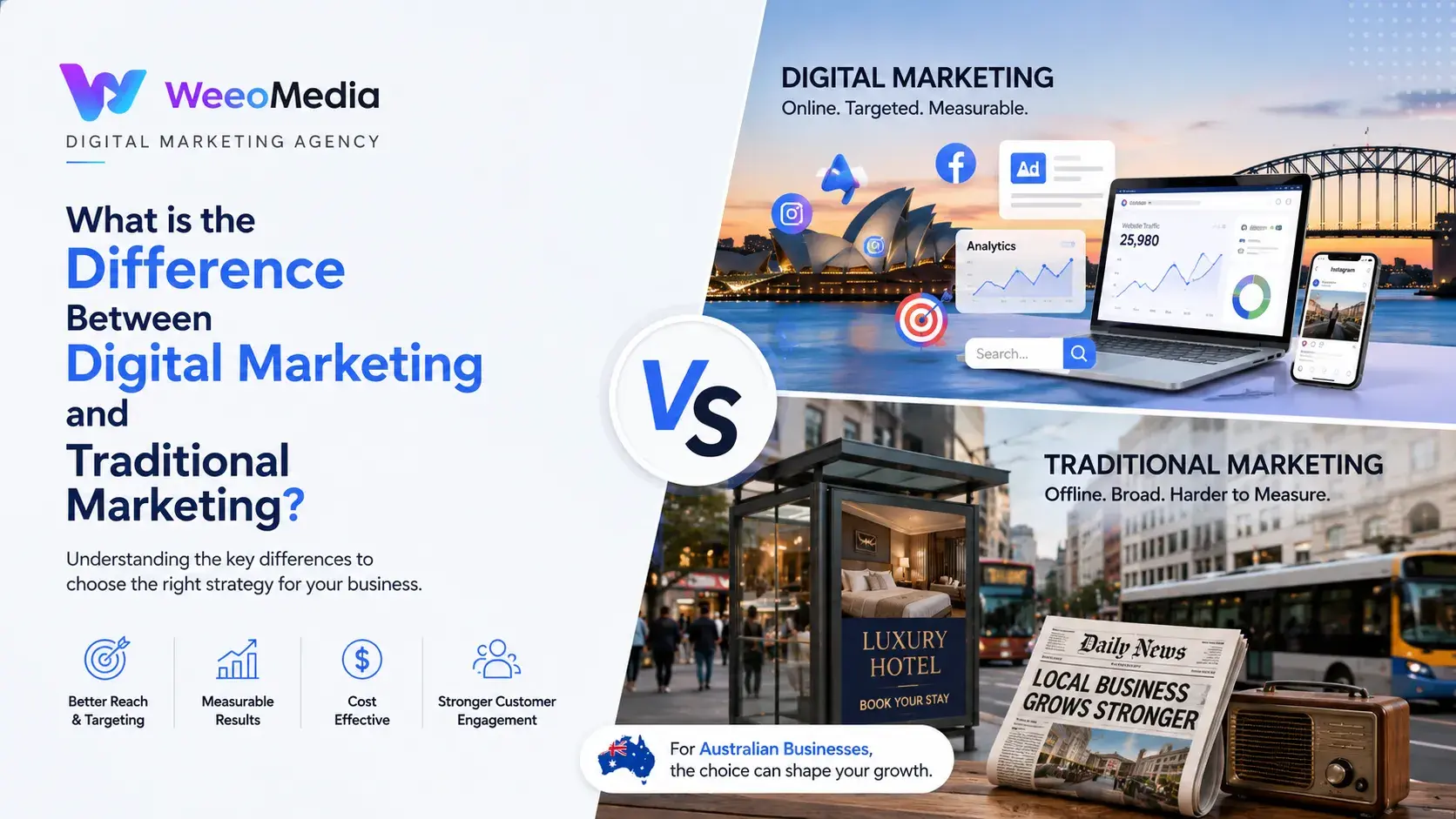
Marketing has always been about one fundamental goal, reaching the right people with the right message at the right time. What has changed dramatically over the past two decades is how that goal is achieved. Businesses today have access to two distinct marketing worlds, the traditional channels that have existed for generations, and the digital channels that have transformed how brands communicate with their audiences.
Understanding the difference between digital marketing and traditional marketing is not just an academic exercise. It is a practical business decision that determines where you invest your budget, how you measure your results, and how effectively you grow your customer base. Whether you are a small local business or a large enterprise, knowing the strengths and limitations of each approach puts you in a far stronger position to make smart marketing decisions.
What is Traditional Marketing?
Traditional marketing refers to any form of promotion that uses offline channels to reach an audience. It is the older of the two approaches, with roots that go back centuries to printed newspapers, posters, and public announcements. In its modern form, traditional marketing includes a wide range of formats that most consumers are familiar with from everyday life.
Print advertising includes newspaper ads, magazine placements, brochures, flyers, and catalogues. Broadcast advertising covers television commercials and radio spots. Outdoor advertising encompasses billboards, transit ads on buses and trains, and signage in public spaces. Direct mail involves sending physical letters, postcards, or catalogues directly to a targeted list of addresses. Telemarketing uses phone calls to reach potential customers directly. Event marketing and sponsorships place a brand in front of live audiences at trade shows, sporting events, concerts, and community gatherings.
Traditional marketing has built some of the world's most recognisable brands over the past century. Its strengths lie in its familiarity, its broad reach, and its ability to create a tangible, physical presence in the lives of consumers. A well-placed billboard on a busy highway or a memorable television commercial can create mass awareness in a way that digital channels sometimes struggle to replicate at the same emotional depth.
However, traditional marketing also comes with significant limitations in the modern business environment. It is generally expensive, particularly for broadcast and outdoor formats. It is difficult to target precisely, often reaching large numbers of people who have no interest in the product or service being promoted. And perhaps most importantly, it is very difficult to measure with accuracy. Knowing exactly how many people saw your newspaper ad, retained the message, and acted on it is nearly impossible to determine with any precision.
What is Digital Marketing?
Digital marketing refers to any promotional activity that uses the internet or electronic devices to reach and engage an audience. It is a broad discipline that encompasses a wide range of channels, tactics, and tools, all connected by the ability to deliver targeted messages, track performance in real time, and adjust strategy based on data.
The major channels within online marketing strategies include search engine optimisation (SEO), which improves a website's visibility in organic search results. Pay-per-click advertising (PPC) places paid ads in search engines and across websites. Social media marketing promotes brands and content on platforms like Facebook, Instagram, LinkedIn, TikTok, and YouTube. Email marketing delivers personalised messages directly to a subscriber's inbox. Content marketing creates and distributes valuable information that attracts and retains a defined audience. Affiliate marketing rewards third-party partners for driving traffic or sales. And influencer marketing leverages the audiences of trusted individuals to promote products and services.
Digital marketing emerged as a mainstream force in the late 1990s and early 2000s with the growth of the internet, and it has accelerated rapidly since the widespread adoption of smartphones. Today, the average person spends several hours each day consuming digital content across multiple devices and platforms, making digital channels the most direct route to a modern consumer's attention.
Key Differences Between Digital Marketing and Traditional Marketing
Understanding how these two approaches differ across several important dimensions helps clarify which is most appropriate for a given business objective, audience, or budget.
Reach and Targeting
Traditional marketing excels at broad reach. A primetime television commercial can reach millions of viewers simultaneously. A national newspaper ad can put your brand in front of a diverse, geographically spread audience overnight. However, that reach is largely untargeted. You are paying to reach everyone who watches a particular channel or reads a particular publication, including the large majority who have no interest in what you are selling.
Targeted digital advertising works very differently. Digital platforms allow you to define your audience with extraordinary precision, targeting by age, location, gender, interests, online behaviour, income level, job title, device type, and much more. A Facebook ad campaign for a gym in Brisbane can be shown exclusively to people aged 25 to 45 living within five kilometres of the gym who have expressed an interest in fitness. This level of precision dramatically reduces wasted spend and improves the efficiency of every dollar invested.
Cost and Budget Flexibility
Traditional marketing is generally expensive and requires significant upfront commitment. A television commercial requires production costs and airtime fees. A billboard requires design, printing, and site rental. Magazine and newspaper placements come with fixed rate card prices that are rarely negotiable for smaller businesses. These costs make traditional marketing largely inaccessible for small businesses and startups operating on limited budgets.
Cost-effective digital marketing offers a very different proposition. Many digital channels can be started with relatively small budgets and scaled up as results are demonstrated. A Google Ads campaign can be launched with a daily budget of twenty dollars. A social media content strategy can be executed with minimal spend beyond the time invested in creating content. SEO, while requiring a long-term investment, delivers organic traffic without a cost-per-click model once rankings are established. This flexibility makes digital marketing accessible to businesses of virtually every size.
Measurability and Analytics
This is perhaps the most significant practical difference between the two approaches. Traditional marketing operates largely in a measurement vacuum. You can estimate the circulation of a magazine or the viewership of a television programme, but you cannot know with certainty how many people saw your ad, how long they engaged with it, or what action they took as a result. Attribution is largely guesswork.
Marketing analytics and ROI tracking in digital marketing operates on an entirely different level. Every click, every impression, every conversion, and every sale can be tracked, attributed, and analysed in real time. Google Analytics shows you exactly how many people visited your website, where they came from, which pages they visited, and whether they completed a desired action. Facebook Ads Manager shows you your cost per click, cost per lead, and return on ad spend down to the individual ad level. This data allows marketers to continuously optimise their campaigns, cutting what is not working and scaling what is, resulting in continuously improving efficiency.
Engagement and Interaction
Traditional marketing is a one-way communication channel. You broadcast your message and the audience receives it passively. There is no mechanism for the audience to respond, ask a question, or share the content with others in a way that amplifies your reach.
Digital marketing is inherently interactive and two-way. A social media post invites comments, shares, and reactions. An email campaign can prompt replies. A blog post can generate discussion in the comments section. A YouTube video can be shared across platforms and accumulate views long after it was published. This interactivity creates opportunities for genuine relationship building between brands and their customers that simply did not exist in the traditional marketing era.
Speed and Agility
Traditional marketing campaigns require significant lead time. Designing, printing, and distributing a brochure takes weeks. Booking and producing a television commercial takes months. Once a campaign is live, making changes is difficult, expensive, or impossible. If the message is wrong or the market changes, you are largely committed to the original approach.
Digital marketing campaign management is agile by nature. A social media ad can be launched in minutes and paused or modified within hours. An email subject line can be A/B tested in real time. A Google Ads campaign can have its budget, targeting, or creative changed instantly based on performance data. This agility allows digital marketers to respond to market shifts, competitive developments, and performance data far faster than any traditional channel permits.
Longevity of Content
Traditional marketing assets are generally temporary. A newspaper ad appears for one day. A television commercial airs during its scheduled slot and is gone. A billboard is replaced when the rental period ends.
Digital content, particularly SEO-driven content and social media assets, can generate value indefinitely. A well-optimised blog post can continue ranking on Google and attracting organic traffic for years after it was published. A YouTube video can accumulate views continuously. An email list, once built, is an asset that can be communicated with repeatedly at minimal cost. This longevity makes digital marketing particularly attractive from a long-term return on investment perspective.
Similarities Between Digital and Traditional Marketing
Despite their many differences, digital and traditional marketing share the same foundational principles. Both require a clear understanding of the target audience. Both demand a compelling message that addresses a genuine need or desire. Both benefit from consistent brand presentation across all formats and channels. And both require ongoing testing, learning, and refinement to improve results over time.
The most successful marketing strategies do not treat digital and traditional as competing alternatives. They recognise that each has a role to play depending on the business objective, the target audience, and the available budget.
Which is Better for Your Business?
The honest answer is that the question of digital versus traditional marketing for businesses rarely has a single correct answer. The right approach depends on several factors specific to your business and audience.
If your target audience is predominantly older, spends more time with traditional media, and makes decisions based on established brand trust, traditional marketing channels may remain highly relevant. If your target audience is younger, digitally active, and researches purchases online before buying, digital channels are likely to deliver far better returns.
For most businesses today, an integrated approach that combines the brand-building strengths of traditional marketing with the precision, measurability, and interactivity of digital marketing delivers the best overall results. A local business might use a community newspaper ad to build awareness among older residents while simultaneously running Google Ads and managing an active social media presence to reach younger audiences. A national brand might run a television campaign for mass awareness while using digital retargeting to re-engage people who visited their website after seeing the ad.
The key is to understand what each channel does best and to allocate your budget accordingly, rather than defaulting to one approach at the expense of the other.
The Rise of Integrated Marketing
The most forward-thinking businesses today are moving beyond the digital versus traditional debate entirely and adopting integrated marketing communication strategies that treat every channel as part of a single, coherent brand experience. In an integrated approach, a television commercial drives viewers to a website. A billboard displays a hashtag that extends the conversation onto social media. A direct mail piece includes a QR code that links to a video or landing page. An email campaign promotes an in-store event.
This integration recognises that modern consumers do not experience brands through a single channel. They encounter brands across multiple touchpoints, both online and offline, and they expect a consistent experience at each one. Businesses that deliver that consistency across both digital and traditional channels build stronger brand recognition, deeper customer trust, and ultimately better commercial results than those that operate each channel in isolation.
Frequently Asked Questions
What is the main difference between digital marketing and traditional marketing?
The main difference lies in the channels used and the ability to measure results. Traditional marketing uses offline channels like television, radio, print, and billboards to reach a broad audience, with limited ability to track performance precisely. Digital marketing uses online channels like search engines, social media, email, and websites to reach targeted audiences, with detailed real-time analytics that track every aspect of campaign performance.
Is digital marketing more effective than traditional marketing?
Digital marketing is generally more cost-effective, measurable, and targeted than traditional marketing, making it the preferred choice for most businesses today. However, traditional marketing retains advantages in building mass brand awareness and reaching audiences that are less digitally active. The most effective approach for many businesses is a combination of both, using each channel where it performs best.
Can small businesses afford digital marketing?
Yes. One of the biggest advantages of digital marketing for small businesses is its flexibility and scalability. Many digital channels, including social media, content marketing, and SEO, can be started with very modest budgets. Even paid channels like Google Ads allow you to set daily spending limits and scale up only when results justify the investment, making digital marketing far more accessible to small businesses than most traditional channels.
What are examples of traditional marketing?
Traditional marketing includes television and radio commercials, newspaper and magazine advertisements, billboards and outdoor signage, direct mail campaigns, flyers and brochures, telemarketing, and event sponsorships. These are all offline channels that deliver messages to audiences without using the internet.
What are examples of digital marketing?
Digital marketing includes search engine optimisation (SEO), pay-per-click advertising (Google Ads), social media marketing on platforms like Facebook, Instagram, and LinkedIn, email marketing campaigns, content marketing through blogs and videos, influencer marketing, affiliate marketing, and online display advertising.
How do I measure the success of a digital marketing campaign?
Digital marketing campaigns are measured using a wide range of metrics depending on the objective. Common metrics include website traffic, keyword rankings, click-through rates, cost per click, cost per lead, conversion rates, return on ad spend, email open rates, social media engagement, and revenue attributed to specific campaigns. Tools like Google Analytics, Google Search Console, and platform-specific ad managers provide detailed data for all of these metrics.
Is traditional marketing still relevant in 2025?
Yes, traditional marketing remains relevant, particularly for businesses targeting older demographics, building mass brand awareness in specific geographic markets, or operating in industries where physical presence and tangible materials carry weight. However, its role has shifted. For most businesses, traditional marketing works best as a complement to digital efforts rather than as a standalone strategy, particularly given the higher costs and limited measurability of traditional channels compared to digital alternatives.
What is integrated marketing and why does it matter? Integrated marketing is an approach that combines digital and traditional marketing channels into a single, coherent strategy where every channel reinforces the others. It matters because modern consumers encounter brands across multiple touchpoints, both online and offline, and expect a consistent experience at each one. Businesses that deliver this consistency across all channels build stronger brand recognition and deeper customer loyalty than those that treat each channel as a separate, isolated activity.