How to Reduce Cost Per Click on Google Ads
Discover actionable strategies to lower your Google Ads cost per click in Australia, from Quality Score improvements to smarter bidding and keyword targeting.
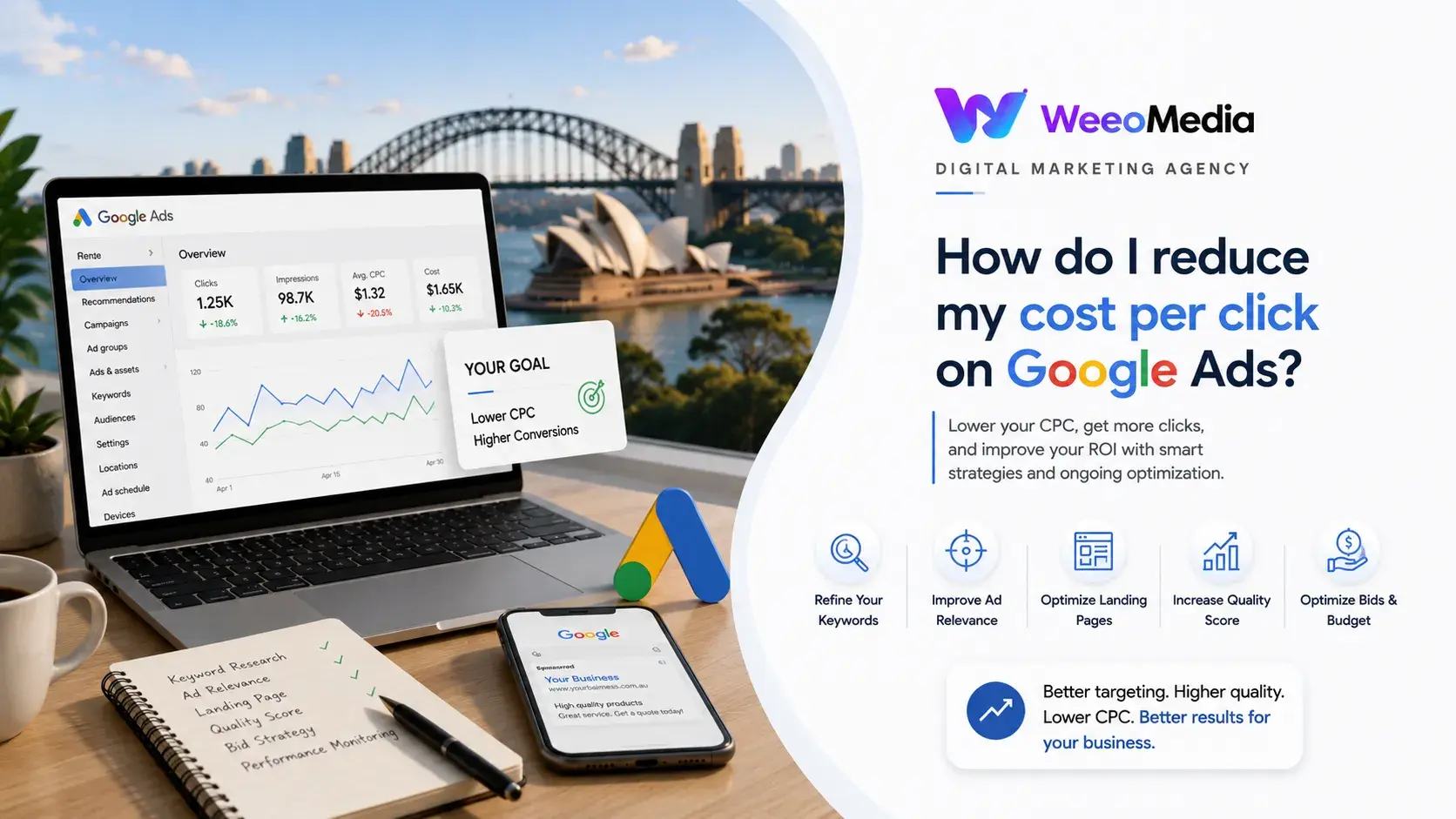
Running Google Ads in Australia can be incredibly powerful, but without the right strategy, your budget can disappear fast. One of the biggest pain points for Australian businesses is a high cost per click (CPC), which eats into profit margins and makes scaling feel impossible.
The good news? With the right approach, you can significantly reduce your Google Ads CPC without sacrificing traffic quality or visibility. In this guide, we'll walk you through proven, up-to-date strategies tailored for the Australian market.
What Is Cost Per Click and Why Does It Matter?
Cost per click (CPC) is the amount you pay every time someone clicks on your Google Ad. In Australia, CPCs vary widely by industry, legal, finance, and real estate sectors often see CPCs above $10–$30, while retail or lifestyle niches tend to be lower.
The lower your CPC, the more clicks, and potential customers, you can reach with the same budget. Reducing your cost per click on Google Ads in Australia is not just about spending less; it's about spending smarter.
1. Improve Your Quality Score
Your Quality Score is one of the single most powerful factors that determines how much you pay per click. Google assigns a Quality Score (on a scale of 1–10) based on three components:
- Expected click-through rate (CTR)
- Ad relevance to the search query
- Landing page experience
A higher Quality Score = a lower CPC. Google rewards advertisers who create relevant, user-friendly ads with better ad positions at lower costs. If your Quality Score sits below 6, your ads are likely costing you more than they should.
How to improve it:
- Match your ad copy closely to the keywords you're bidding on
- Create dedicated landing pages for each ad group
- Ensure your landing page loads quickly on mobile, especially important in Australian markets where mobile search dominates
- Write compelling ad copy with clear calls-to-action
2. Use Negative Keywords Strategically
One of the fastest ways to lower your Google Ads CPC in Australia is by eliminating wasted spend using negative keywords. These tell Google which searches you don't want your ads to appear for.
For example, if you're a premium accounting firm in Sydney, you'd want to add "free", "cheap", and "DIY" as negative keywords to avoid attracting low-intent clicks.
Best practices:
- Run a Search Terms report weekly to identify irrelevant queries
- Build a robust negative keyword list from day one
- Segment negatives at the campaign and ad group level
- Use exact and phrase match negatives for precision
Proper use of negative keywords can reduce wasted ad spend by 15–30%, meaning your budget goes further with every dollar.
3. Tighten Your Keyword Match Types
Broad match keywords might seem like a great way to capture volume, but they often lead to irrelevant clicks that inflate your CPC and drain your budget. Moving toward phrase match and exact match keywords gives you far more control.
For Australian campaigns, consider using location-specific terms such as "Google Ads agency Melbourne" or "plumber near Brisbane", these long-tail, geo-specific searches often have lower competition and lower CPC, while delivering higher conversion intent.
Recommended approach:
- Start with phrase and exact match keywords
- Review Search Terms regularly to expand with intent-driven terms
- Gradually test broad match only once you have strong negative keyword lists in place
4. Leverage Smart Bidding the Right Way
Google's Smart Bidding strategies use machine learning to optimise your bids in real time. However, many Australian advertisers make the mistake of jumping straight to automated bidding without the right data foundation.
Smart bidding works best when:
- Your campaign has at least 30–50 conversions per month
- Your conversion tracking is correctly set up in Google Ads and GA4
- You've given the algorithm at least 2–4 weeks to learn
Recommended smart bidding strategies to lower CPC while maintaining performance:
- Target CPA (Cost Per Acquisition): Ideal if you have a clear cost target per lead or sale
- Target ROAS (Return on Ad Spend): Perfect for e-commerce businesses in Australia
- Maximise Conversions with a Target CPA cap: A safer way to enter automated bidding
Avoid jumping straight to "Maximise Clicks", it prioritises volume over quality and often inflates CPC unnecessarily.
5. Refine Your Ad Scheduling and Device Targeting
Not all clicks are equal, and not all hours of the day perform the same. Australian businesses often see significant differences in conversion rates between weekday mornings and late Friday evenings, for instance.
Ad scheduling tips:
- Analyse your hourly and day-of-week performance data in Google Ads
- Apply bid adjustments to reduce bids during low-converting periods
- Pause ads during hours when you have no capacity to respond to leads
Device targeting:
- Check your conversion rates across desktop, mobile, and tablet
- Apply negative bid adjustments on devices with poor ROI
- Ensure your landing page is fully mobile-optimised, especially for B2C campaigns targeting Australian consumers
6. Improve Ad Relevance with Tighter Ad Groups
One often-overlooked factor in Google Ads campaign optimisation is ad group structure. Large, bloated ad groups with 50+ keywords are a recipe for poor relevance scores and higher CPCs.
Instead, use Single Keyword Ad Groups (SKAGs) or tightly themed ad groups of 5–10 related keywords. This ensures:
- Your ads closely match what users are searching for
- Your CTR improves, boosting Quality Score
- Your CPC decreases as a result
For example, rather than one ad group targeting "electrician Sydney", "licensed electrician Sydney", and "emergency electrician near me", break these into separate, tightly focused groups with tailored ad copy for each.
7. Test and Optimise Ad Copy Continuously
High CTR directly improves your Quality Score, which in turn reduces your cost per click on Google Ads. Running regular A/B tests on your ad headlines and descriptions is one of the most effective ways to drive up CTR.
Tips for Australian advertisers:
- Use Australian-specific language and pricing (e.g., "$" not "USD")
- Highlight trust signals: "Australian-owned", "5-star rated", "same-day service"
- Use ad extensions (now called "assets"), sitelinks, callouts, structured snippets, and call extensions all improve visibility at no extra cost per click
- Test Responsive Search Ads (RSAs) with at least 8–10 diverse headlines
Google's latest updates favour RSAs with strong Ad Strength scores, aim for "Excellent" to gain a competitive edge and lower CPC.
8. Audit Your Campaign Structure and Settings
A poorly configured campaign can silently inflate your CPC. As part of a regular Google Ads campaign optimisation routine, audit the following:
- Search partners: If you're running on Google Search Network, check whether Search Partners are performing well or draining budget, disable them if ROI is poor
- Display Network opt-in: Ensure search campaigns are NOT opted into the Display Network (a common default setting that wastes budget)
- Location targeting: Use "Presence: People in or regularly in your targeted locations" rather than "Presence or interest" to avoid clicks from outside Australia
- Audience targeting: Layer in in-market and remarketing audiences to improve relevance and conversion rates
9. Monitor Auction Insights and Competitor Activity
The Google Ads auction insights report reveals who else is bidding on your keywords in Australia. If you notice aggressive competitors during certain periods, you can strategically reduce bids during those times and focus budget when competition is lower.
Monitoring your Impression Share is equally important, if you're losing impression share due to budget, you may be spreading spend too thin. Consolidating campaigns and keywords often leads to lower CPC and better overall performance.
10. Work With a Local Google Ads Specialist
Finally, if managing all of this feels overwhelming, partnering with an experienced PPC management Australia specialist can deliver significant CPC reductions while freeing up your time.
A local expert understands Australian consumer behaviour, seasonal trends (like end-of-financial-year buying surges), and local compliance nuances, all of which can make a measurable difference to your campaign performance.
Key Takeaways
Reducing your cost per click on Google Ads in Australia is entirely achievable with the right strategy. Focus on improving Quality Score, eliminating irrelevant traffic with negative keywords, tightening your ad group structure, and using Smart Bidding intelligently. Combine this with continuous testing and regular audits, and you'll see your CPC come down while your ROI goes up.
Frequently Asked Questions (FAQ)
Q1: What is a good cost per click for Google Ads in Australia? A "good" CPC varies significantly by industry. On average, Australian businesses pay between $1–$5 per click in less competitive industries, and $10–$40+ in sectors like law, finance, or real estate. The key metric to track isn't just the CPC, but the cost per conversion relative to the lifetime value of a customer.
Q2: How long does it take to see a reduction in Google Ads CPC? Some improvements, like adding negative keywords or refining match types, can show results within days. Others, like improving Quality Score through landing page updates, may take 2–4 weeks to reflect in your CPC. Smart Bidding algorithms typically need 4–6 weeks of data to fully optimise.
Q3: Does a higher Google Ads budget lower my CPC? Not directly. CPC is determined by your Quality Score and the competition in each auction, not your budget size. However, a larger budget allows campaigns to gather conversion data faster, which can help Smart Bidding strategies perform more efficiently and indirectly lead to better CPC over time.
Q4: What is Quality Score and how does it affect my CPC? Quality Score is Google's rating (1–10) of the relevance and quality of your keywords, ads, and landing pages. A higher Quality Score means Google considers your ad more relevant to users, rewarding you with better ad positions at a lower CPC. Moving from a Quality Score of 5 to 8 can reduce your CPC by 30–50%.
Q5: Are negative keywords important for reducing CPC in Australia? Absolutely. Negative keywords prevent your ads from showing for irrelevant searches, reducing wasted clicks and improving your overall campaign relevance. This indirectly improves your CTR and Quality Score, both of which lead to lower CPC. It's one of the fastest, most impactful optimisations you can make.
Q6: Should I use Smart Bidding or manual bidding to reduce CPC? It depends on your data volume. If you have fewer than 30 conversions per month, manual bidding with Enhanced CPC gives you more control. If you have sufficient conversion data, Smart Bidding strategies like Target CPA can optimise bids more efficiently than manual management and often result in better CPC efficiency over time.
Q7: How does ad relevance impact cost per click? Ad relevance is a component of Quality Score. When your ad copy closely matches the keywords you're targeting, Google sees your ad as more relevant to the user's query. This boosts your Quality Score, which in turn lowers the amount you need to bid to maintain your ad position, effectively reducing your CPC.
Q8: Is it worth hiring a Google Ads specialist in Australia to lower CPC? For most businesses spending $2,000+ per month on Google Ads, working with a certified Australian Google Ads specialist is highly worthwhile. They can identify inefficiencies, implement advanced strategies, and deliver CPC reductions that far outweigh the cost of management, typically improving ROI within the first 60–90 days.