What is Pay Per Click Advertising and is it Worth it in Australia?
Understand what Pay Per Click advertising is, how it works in Australia in 2026, and whether it is a worthwhile investment for your business based on your industry, budget, and goals.
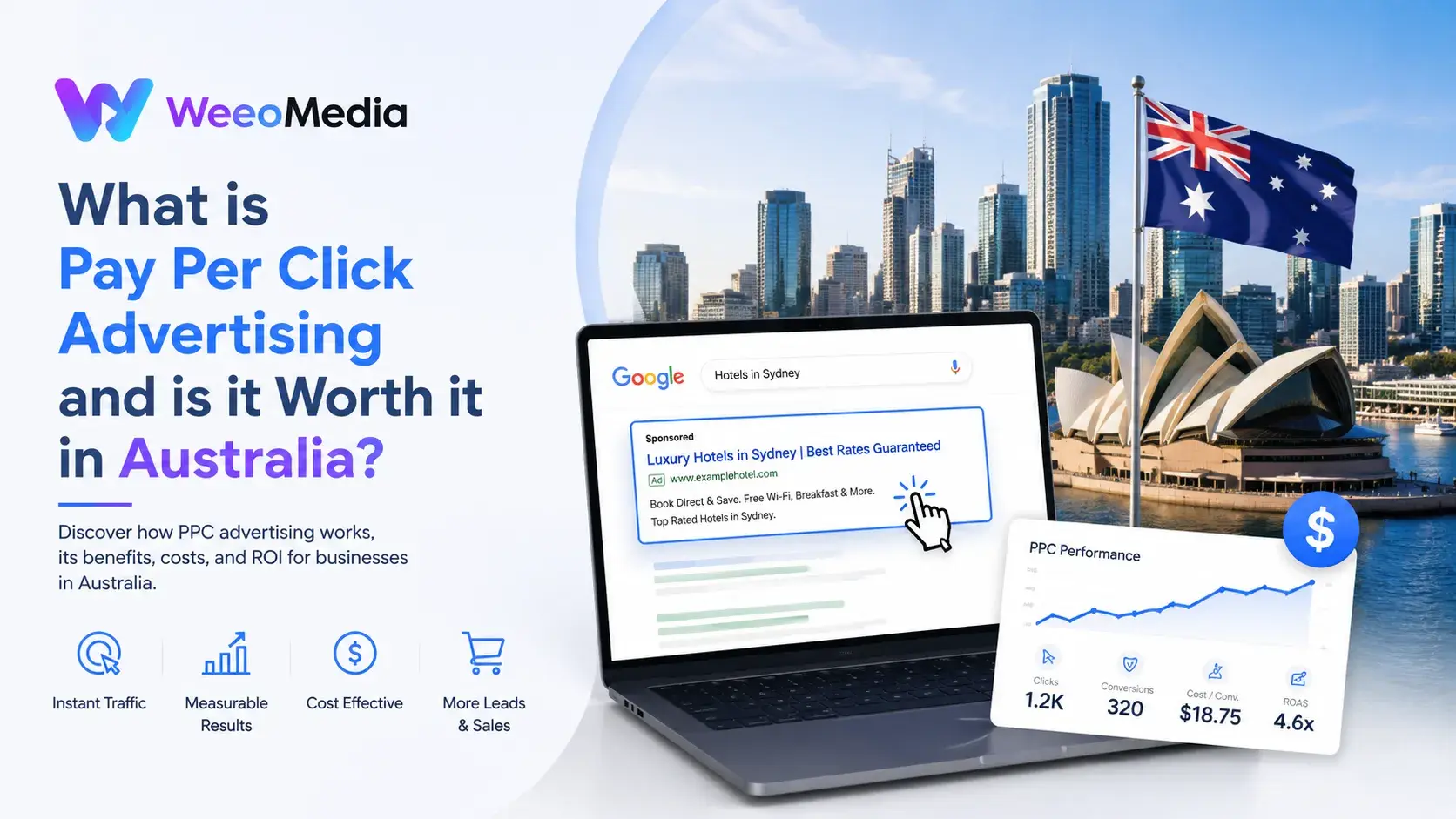
Digital advertising has transformed the way Australian businesses reach their customers. Among the many options available, Pay Per Click advertising has emerged as one of the most widely used and debated channels in the digital marketing landscape. Business owners across Australia, from small local retailers in regional towns to large e-commerce brands in Sydney and Melbourne, are asking the same fundamental question. Is Pay Per Click advertising actually worth the investment, or is it a fast way to burn through a marketing budget with little return?
This blog answers that question in full. We explain what Pay Per Click advertising is, how it works in the Australian market in 2026, which businesses benefit most from it, and what it takes to run campaigns that deliver genuine, measurable return on investment.
What is Pay Per Click Advertising?
Pay Per Click advertising, commonly referred to as PPC, is a model of digital advertising in which the advertiser pays a fee each time a user clicks on their ad. Rather than paying a flat rate for an advertisement to be displayed, you pay only when someone actively engages with your ad by clicking through to your website, landing page, or booking form.
The most widely used PPC platform in Australia is Google Ads, which places paid advertisements at the top and bottom of Google search results pages. Other significant PPC platforms include Microsoft Advertising, which displays ads on Bing and partner networks, Meta Ads on Facebook and Instagram, LinkedIn Ads for business-to-business targeting, and YouTube Ads for video-based campaigns.
Pay Per Click advertising in Australia operates through a real-time bidding system. When a user performs a search or visits a webpage, an automated auction takes place in milliseconds to determine which ads are shown and in what order. Advertisers set bids representing the maximum amount they are willing to pay for a click, but the actual cost per click is determined by the competitiveness of the auction and the quality of the ad itself.
The key distinction between PPC and other forms of digital marketing is control and immediacy. You set the budget, you choose who sees your ads, and your ads can appear within hours of launching a campaign. This makes PPC one of the fastest ways to generate traffic and leads for an Australian business, particularly when compared to organic SEO, which builds visibility over a longer timeframe.
How Does Pay Per Click Advertising Work in 2026?
The mechanics of PPC advertising have evolved significantly over the past few years, and in 2026 the landscape is more automated, more audience-driven, and more integrated across platforms than ever before.
The Auction System
Every time a user performs a search on Google, an auction determines which ads appear. Your ad's eligibility and position in that auction are determined by two primary factors, your bid amount and your Quality Score.
Your bid is the maximum amount you are willing to pay for a single click. Your Quality Score is Google's assessment of the relevance and quality of your keyword, your ad copy, and the landing page experience you provide to users who click. A business with a high Quality Score can achieve better ad positions at a lower cost per click than a competitor with a higher bid but weaker relevance. This rewards businesses that invest in well-structured, relevant campaigns rather than simply outspending competitors.
Smart Bidding and Automation
In 2026, PPC campaign management in Australia is heavily influenced by machine learning and automated bidding strategies. Google's Smart Bidding uses historical conversion data and real-time signals to automatically set bids for each auction, optimising toward your chosen goal, whether that is maximising conversions, achieving a target cost per acquisition, or delivering a specific Return on Ad Spend.
For businesses with sufficient conversion data, Smart Bidding strategies like Target ROAS and Maximise Conversions consistently outperform manual bidding by factoring in hundreds of contextual signals simultaneously, including the user's device, location, time of day, search history, and audience characteristics.
Campaign Types Available in Australia
Australian businesses have access to a broad range of PPC campaign types across Google Ads and other platforms.
Search campaigns display text ads at the top of Google search results for chosen keywords. Display campaigns show visual banner ads across the Google Display Network of millions of websites and apps. Shopping campaigns display product listings with images, prices, and store names for e-commerce businesses. Performance Max campaigns use automation to serve ads across all Google channels simultaneously from a single campaign. Video campaigns deliver ads before, during, and after YouTube videos. App campaigns promote mobile app downloads across Google's networks.
The Australian PPC Landscape in 2026
Australia's digital advertising market has grown substantially, and competition for paid search placements has intensified across virtually every industry. Understanding the current landscape is essential for setting realistic expectations and building effective strategies.
Cost per click trends in Australia vary enormously by industry. Legal services, financial products, healthcare, and real estate consistently command the highest average cost per click figures among all Australian industries. Retail, hospitality, and travel sit in a mid-range bracket, while some niche local service industries can still achieve competitive placements at relatively modest cost per click rates.
Mobile search now accounts for the majority of Google searches in Australia, and this has significant implications for PPC strategy. Ads and landing pages that are not optimised for mobile users will consistently underperform, regardless of how well the rest of the campaign is structured.
Voice search and conversational query patterns have also continued to grow in Australia, influencing keyword strategy. Campaigns in 2026 need to account for the longer, more natural phrasing that voice search users employ, which often differs meaningfully from traditional typed search queries.
The dominance of Performance Max campaigns has changed how many Australian advertisers structure their accounts. While Performance Max delivers genuine efficiency gains for businesses with strong creative assets and clear conversion goals, it also requires careful setup and monitoring to prevent budget from being directed toward low-value placements.
Benefits of Pay Per Click Advertising for Australian Businesses
PPC advertising benefits for Australian businesses are substantial when campaigns are planned and managed effectively. Here is why thousands of Australian businesses continue to invest in the channel in 2026.
Immediate visibility: Unlike SEO, which takes months to deliver ranking improvements, a well-configured Google Ads campaign can place your business at the top of search results on the same day it goes live. For new businesses, seasonal promotions, or time-sensitive offers, this immediacy is invaluable.
Precise audience targeting: PPC platforms offer targeting options that no traditional advertising medium can match. You can target users based on the specific words they search for, their geographic location down to suburb level in Australia, the device they are using, the time of day, their demographic profile, their past interactions with your website, and their broader interests and behaviours.
Complete budget control: You set the daily and monthly budget limits, and spending never exceeds what you authorise. This makes PPC accessible for businesses of all sizes, from sole traders spending a few hundred dollars per month to national brands investing six figures.
Measurable return on investment: Every aspect of a PPC campaign is measurable. You can track exactly how many people saw your ad, how many clicked, how many completed a purchase or enquiry, and how much revenue each campaign generated. This level of accountability is one of PPC's greatest advantages over traditional advertising channels.
Competitive market access: PPC allows small and medium-sized Australian businesses to compete for visibility in markets where larger competitors dominate organic search results. A local law firm in Brisbane can appear above national legal directories for specific search queries through a well-targeted paid campaign.
Remarketing capability: PPC platforms allow you to target users who have previously visited your website but did not convert. Google Ads remarketing in Australia is particularly effective because it reaches an audience that has already demonstrated interest in your product or service, making them significantly more likely to convert than cold traffic.
Is Pay Per Click Advertising Worth it for Australian Businesses in 2026?
This is the central question, and the honest answer is that it depends on how the campaigns are planned, managed, and measured. PPC advertising is absolutely worth it for Australian businesses that approach it correctly. It can be an expensive lesson for those who do not.
Here are the key factors that determine whether PPC delivers genuine value for an Australian business.
Industry and Competition Level
In highly competitive industries with high customer lifetime values, such as legal services, financial planning, real estate, and healthcare, PPC is often essential because organic search results are dominated by large, established competitors with years of SEO investment behind them. The cost per click is higher in these sectors, but the revenue from a single converted client often justifies the investment many times over.
For businesses in less competitive local markets or niche industries, PPC can deliver outstanding returns even on modest budgets, because cost per click rates are lower and the competition for ad placements is less intense.
Average Order Value and Customer Lifetime Value
Return on investment for PPC advertising is directly tied to the value of the customers it generates. A business with an average transaction value of five thousand dollars can afford a significantly higher cost per acquisition than a business with an average transaction value of fifty dollars. Before investing in PPC, Australian businesses should calculate their maximum acceptable cost per acquisition based on their profit margins and ensure their target keywords can realistically deliver clicks at a cost that makes the economics work.
Campaign Quality and Management
This is perhaps the most significant determining factor. A well-structured PPC campaign with tightly themed ad groups, relevant keywords, compelling ad copy, optimised landing pages, and consistent monitoring can deliver exceptional return on investment. A poorly structured campaign with broad keywords, generic ad copy, and traffic sent to an irrelevant homepage can exhaust a budget within days with nothing to show for it.
Google Ads management for small businesses in Australia is one of the most searched services in the digital marketing industry, and for good reason. Many business owners have experienced the frustration of setting up a campaign independently, spending their budget quickly, and seeing minimal results. Working with an experienced PPC specialist who understands the Australian market significantly improves the likelihood of achieving profitable outcomes.
Landing Page Experience
The quality of the page a user arrives at after clicking an ad is one of the most overlooked factors in PPC performance. Sending paid traffic to a poorly designed, slow-loading, or irrelevant page wastes every dollar spent on clicks. An effective landing page speaks directly to the intent of the search query, loads in under three seconds on mobile, presents a clear value proposition, builds trust through social proof, and guides the visitor toward a single, clearly defined conversion action.
Conversion Tracking and Data
Businesses that run PPC without accurate conversion tracking are essentially driving blind. Without knowing which keywords, ads, and campaigns are generating actual bookings, leads, or purchases, it is impossible to optimise intelligently or demonstrate return on investment. Setting up complete conversion tracking before spending a single dollar on paid advertising is an absolute prerequisite for any Australian business serious about making PPC work.
Industries Where PPC Delivers Strong Results in Australia
While PPC can work for virtually any business with sufficient search demand for its products or services, certain industries consistently achieve strong results from paid search campaigns in the Australian market in 2026.
E-commerce: Shopping campaigns and search campaigns targeting product-specific keywords deliver highly measurable return for Australian online retailers. The ability to match specific product searches with precise product listings makes Google Shopping particularly effective for e-commerce businesses.
Professional services: Law firms, accounting practices, financial planners, and consultancies benefit enormously from PPC because potential clients actively search for these services at moments of high need, and the value of a single converted client is substantial.
Healthcare and medical: Dental practices, physiotherapy clinics, specialist medical providers, and allied health professionals in Australia find PPC highly effective for attracting new patients searching for specific treatments or services in their local area.
Home services: Plumbers, electricians, builders, landscapers, and other trades benefit from local PPC advertising in Australia targeting suburb and city-specific service queries. These searches carry very high intent, and the first business to appear often wins the enquiry.
Tourism and hospitality: Hotels, tour operators, and travel agencies use PPC to capture travellers at the booking stage, drive direct reservations, and promote seasonal packages to both domestic and international audiences.
Education and training: Registered training organisations, universities, and private course providers use PPC to reach students searching for specific qualifications, courses, or study modes at the moment they are ready to enrol.
How Much Does Pay Per Click Advertising Cost in Australia?
One of the most common questions from Australian business owners considering PPC is how much they should expect to spend. The answer varies considerably based on industry, location, competition, and campaign objectives.
There is no minimum spend requirement on Google Ads. Campaigns can technically be started with as little as a few dollars per day. However, in practice, most industries in Australia require a meaningful daily budget to generate sufficient impression share, accumulate conversion data, and allow automated bidding strategies to optimise effectively.
For small to medium-sized Australian businesses, a starting monthly budget of between one thousand and three thousand dollars is generally sufficient to test PPC viability, gather meaningful data, and identify profitable keyword clusters. Businesses in highly competitive sectors like legal, financial, and real estate typically need significantly higher budgets to achieve competitive impression share.
In addition to the advertising spend itself, professional PPC management costs should be factored in. Agency management fees for PPC services in Australia typically range from a percentage of ad spend to a flat monthly retainer, depending on the scope and complexity of the campaigns being managed.
PPC vs SEO, Which is Right for Your Australian Business?
PPC and SEO are frequently compared as competing investment options, but in reality they serve different purposes and work most effectively in combination.
PPC delivers immediate, controllable visibility with a direct cost attached to every click. It is ideal for generating fast results, promoting time-sensitive offers, testing new markets, and filling revenue gaps while organic rankings build over time.
SEO builds long-term organic authority that delivers compounding traffic growth without a cost per click. It takes longer to produce results but creates a durable asset that generates free traffic month after month once rankings are established.
For most Australian businesses in 2026, the most effective digital strategy combines both channels. PPC fills the short-term pipeline while SEO builds sustainable long-term visibility. The data gathered from PPC campaigns, particularly insights into which keywords convert and which messages resonate, directly informs and accelerates SEO strategy.
Choosing one over the other entirely often means sacrificing either speed or sustainability. The businesses that grow most consistently online are those that treat PPC and SEO as complementary parts of a unified strategy rather than either-or options.
Frequently Asked Questions
What is Pay Per Click advertising and how does it work in Australia?
Pay Per Click advertising is a digital advertising model where businesses pay a fee each time a user clicks on one of their ads. In Australia, the most commonly used PPC platform is Google Ads, which places paid ads at the top of search results. Advertisers bid on keywords relevant to their business, and ads appear when users search for those terms. The cost per click is determined by a real-time auction that factors in both bid amount and the quality and relevance of the ad.
Is Google Ads worth it for small businesses in Australia in 2026?
Yes, Google Ads can be highly effective for small businesses in Australia when campaigns are well structured and properly managed. The key is targeting specific, relevant keywords with clear commercial intent, writing compelling ad copy, sending traffic to optimised landing pages, and tracking conversions accurately. Small businesses with limited budgets can achieve strong results by focusing on niche, location-specific, or long-tail keywords with lower competition and cost per click.
How much does Pay Per Click advertising cost in Australia?
The cost varies significantly by industry, location, and keyword competitiveness. Average cost per click in Australia ranges from under one dollar for niche or low-competition searches to over fifty dollars for highly competitive industries like legal services and financial products. Most small to medium businesses start with a monthly budget between one thousand and three thousand dollars to generate meaningful data and assess campaign viability.
How long does it take to see results from PPC advertising in Australia? PPC can generate clicks and conversions almost immediately after a campaign goes live. However, campaign performance typically improves significantly over the first four to eight weeks as conversion data accumulates and automated bidding strategies optimise. Expect the first month to be a testing and learning period, with meaningful performance data available by the end of the second month.
What is a good Return on Ad Spend for Australian PPC campaigns?
A healthy Return on Ad Spend, commonly referred to as ROAS, varies by industry and business model. For e-commerce businesses, a ROAS of 4 to 1, meaning four dollars of revenue for every one dollar of ad spend, is a commonly cited benchmark, though many well-optimised campaigns achieve significantly higher ratios. For lead generation businesses, cost per lead and cost per acquisition are typically more meaningful metrics than ROAS.
What is the difference between PPC and SEO for Australian businesses?
PPC delivers paid, immediate visibility in search results with a cost attached to every click. SEO builds organic, unpaid visibility over time through content quality, technical optimisation, and backlink authority. PPC is faster to produce results and offers more direct control over targeting and budget. SEO is a longer-term investment that delivers compounding traffic growth without ongoing cost per click. Most Australian businesses benefit from using both strategies together.
Can I manage my own Google Ads campaign as an Australian business owner?
Yes, Google Ads is accessible to anyone, and many Australian business owners manage their own campaigns. However, running campaigns effectively in competitive markets requires expertise in keyword strategy, audience targeting, bid management, ad copywriting, landing page optimisation, and performance analysis. Poorly managed campaigns can waste budget quickly. If you do not have the time or expertise to manage campaigns actively, working with an experienced PPC specialist is likely to deliver a significantly better return on your advertising investment.
What industries benefit most from PPC advertising in Australia?
PPC advertising delivers strong results across a wide range of Australian industries. Professional services including legal, accounting, and financial planning benefit from PPC due to high client lifetime values. Healthcare, home services, e-commerce, tourism, hospitality, education, and real estate all achieve strong outcomes when campaigns are properly structured and managed. Even niche local businesses can achieve excellent return from well-targeted local PPC campaigns.