What Is Technical SEO and Does My Website Need It?
Technical SEO is the process of optimising your website's underlying infrastructure so search engines can efficiently find, crawl, and index your pages. This guide explains what technical SEO covers, how it differs from on-page SEO, why it matters for your rankings, and how to know whether your website needs a technical SEO audit.
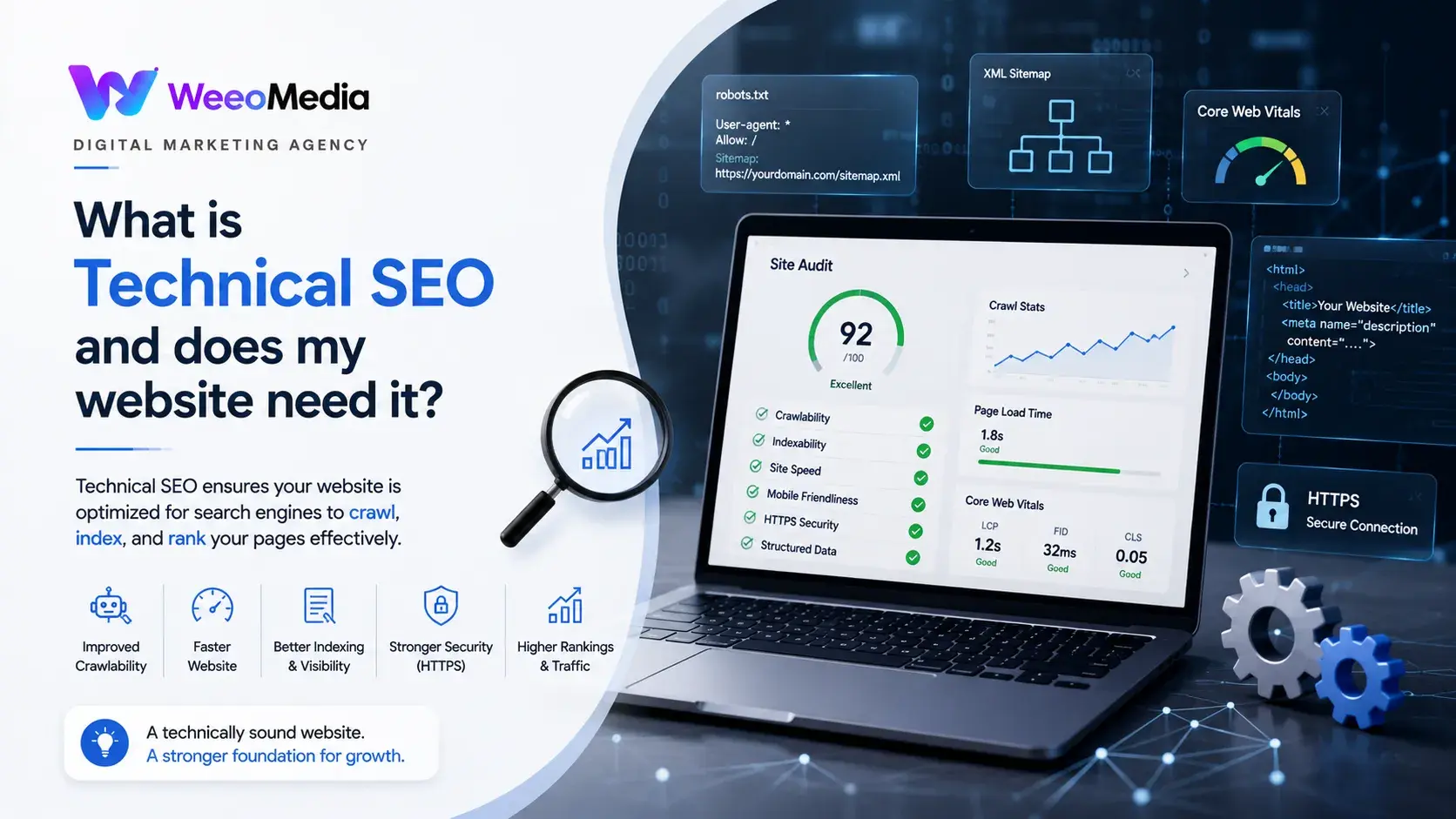
If you have spent any time researching how to improve your website's visibility on Google, you have almost certainly come across the term technical SEO. It gets mentioned in marketing blogs, agency proposals, and SEO audits with impressive regularity, but it is not always explained clearly. What exactly does it mean? How is it different from the other types of SEO you may have heard about? And most importantly, does your website actually need it? This guide answers all of those questions in plain, straightforward language so you can make informed decisions about your website and your digital marketing investment.
What Is Technical SEO?
Technical SEO is the process of optimising the underlying infrastructure of your website so that search engines like Google can efficiently find, crawl, understand, and index your pages. While other forms of SEO focus on what your website says, technical SEO focuses on how your website is built and how it performs.
Think of it this way. You could have the most well-written, relevant, and genuinely useful content on the internet, but if your website loads slowly, has broken links, is not mobile-friendly, or has structural issues that prevent Google from reading it properly, that content will never rank as well as it should. Technical SEO removes the barriers that stand between your website and strong search engine performance.
It is one of three core pillars of a complete SEO strategy, the other two being on-page SEO, which covers content and keyword optimisation, and off-page SEO, which covers link building and external authority signals. All three matter, but technical SEO is the foundation. Without it, the other two are significantly less effective.
What Does Technical SEO Actually Cover?
Technical SEO is a broad discipline that covers a wide range of factors. Here are the most important ones and why they matter.
Site Speed and Core Web Vitals
Page speed is one of Google's confirmed ranking factors. A website that loads slowly frustrates users and signals poor quality to search engines. Core Web Vitals are a specific set of speed and user experience metrics that Google introduced as ranking signals, covering how quickly the largest element on a page loads, how quickly the page becomes interactive, and how much the page layout shifts as it loads. Improving these metrics is a central part of technical SEO optimisation and can have a direct and significant impact on your rankings.
Mobile-Friendliness
Google now uses mobile-first indexing, which means it primarily uses the mobile version of your website to determine your rankings, even for desktop searches. If your website does not work well on smartphones and tablets, it is being evaluated on its weakest version. A technical SEO audit will always include a thorough assessment of your website's mobile performance and flag any issues that need to be addressed.
Crawlability and Indexation
Before Google can rank your pages, it needs to be able to find and read them. Crawlability refers to how easily Google's bots can navigate your website and access all of your pages. Indexation refers to whether Google is actually storing and including your pages in its search index. Technical SEO covers the setup and optimisation of your robots.txt file, which tells Google which pages to crawl and which to ignore, and your XML sitemap, which helps Google discover and understand the structure of your website.
HTTPS and Website Security
Google uses HTTPS as a ranking signal and marks non-HTTPS websites as not secure in the Chrome browser. If your website is still running on HTTP, migrating to HTTPS is a basic technical SEO requirement that also protects your visitors' data and builds trust with your audience.
Structured Data and Schema Markup
Structured data is a standardised way of providing additional information about your website's content to search engines. By adding schema markup to your pages, you can help Google understand what your content is about more precisely, and in some cases enable rich results in search, such as star ratings, FAQ dropdowns, product prices, and event details, that make your listing more eye-catching and increase your click-through rate.
URL Structure and Site Architecture
A clean, logical URL structure and a well-organised site architecture make it easier for both search engines and users to navigate your website and understand the relationship between different pages. Poor site architecture can lead to crawl budget waste, orphaned pages that Google never finds, and a diluted internal linking structure that fails to pass authority effectively between your pages.
Duplicate Content
When multiple pages on your website contain the same or very similar content, search engines can struggle to determine which version to rank, which can split your ranking signals and weaken all of the affected pages. Technical SEO addresses duplicate content issues through canonical tags, which tell Google which version of a page is the preferred one, and through proper redirect management to ensure that duplicate URLs are consolidated correctly.
Broken Links and Redirect Chains
Broken links, pages that return a 404 error, and long chains of redirects create a poor user experience and waste your crawl budget. A thorough website technical SEO review will identify all broken links and redirect issues and provide clear recommendations for resolving them.
How Is Technical SEO Different from On-Page SEO?
This is a question many people have and it is worth answering clearly. On-page SEO is focused on the content of your individual pages, including keyword research and usage, title tags, meta descriptions, heading structures, content quality, and internal linking strategy. It is about making sure each page is as relevant and valuable as possible for the topics and keywords you want to rank for.
Technical SEO is focused on the infrastructure that supports all of those pages. It is about making sure your website is fast, secure, accessible to search engines, free of errors, and structurally sound. The two disciplines are closely related and both are essential, but they address different aspects of how a website performs in search.
A helpful analogy is a physical shop. On-page SEO is like the quality of the products in your shop, the way they are displayed, and the helpfulness of your staff. Technical SEO is like the building itself, whether the doors open properly, whether the lighting works, whether customers can navigate the aisles without obstruction. Both matter, but the building needs to be functional before anything else can work.
Does My Website Actually Need Technical SEO?
The short answer is yes, almost certainly. Here is why.
Every website has technical issues to some degree. Some are minor and have a limited impact on rankings. Others are significant and are actively preventing your website from performing as well as it should. The only way to know for sure is to conduct a proper technical SEO audit of your website.
That said, there are some situations where the need for technical SEO attention is particularly clear.
If your website is not ranking well despite having good content and some backlinks, technical issues may be the root cause. If your website loads slowly, if it has never been properly audited, if it was built a few years ago without much attention to SEO best practices, if it has been through a redesign or migration without proper redirect management, or if it has grown significantly in size and complexity over time, the likelihood of significant technical issues is high.
If you run an e-commerce website with hundreds or thousands of product pages, technical SEO is absolutely critical. Large websites are far more susceptible to crawl budget issues, duplicate content problems, and indexation challenges that can significantly undermine organic performance if not managed carefully.
If you are investing in content marketing and link building, you are essentially pouring fuel into an engine that may have a serious mechanical problem. Technical SEO fixes the engine so that every other investment you make in your website has the best possible chance of delivering the results you are expecting.
What Happens If You Ignore Technical SEO?
Ignoring technical SEO issues does not mean they go away. It means they quietly undermine your website's performance while you continue to invest in content and links that cannot reach their full potential. Over time, unresolved technical issues can lead to pages being deindexed, rankings dropping after algorithm updates that specifically target technical quality signals, a poor user experience that drives visitors away, and a growing gap between your website's performance and that of competitors who are investing in their technical foundations.
Google's algorithm is updated hundreds of times every year, and many of those updates place increasing weight on technical quality signals like Core Web Vitals, mobile usability, and page experience. A website that is technically sound today will be better positioned to weather these updates than one that is not.
How Do You Know If Your Website Has Technical SEO Problems?
The most reliable way to identify technical SEO problems is to conduct a comprehensive technical SEO audit using professional tools and expert analysis. Tools like Google Search Console, which is free and provided directly by Google, can surface a range of technical issues including crawl errors, mobile usability problems, Core Web Vitals failures, and indexation issues. More advanced tools like Screaming Frog, Ahrefs, and Semrush provide deeper analysis of site architecture, duplicate content, broken links, redirect chains, and more.
However, interpreting the output of these tools and prioritising which issues to address first requires expertise and experience. A professional technical SEO audit conducted by an experienced specialist will not only identify the issues but also explain their impact and provide a clear, prioritised roadmap for addressing them.
How Often Should You Conduct a Technical SEO Audit?
For most websites, a comprehensive technical SEO audit at least once a year is a sensible baseline. However, there are specific situations that call for an audit outside of this regular cycle. If your website undergoes a redesign or a platform migration, a technical SEO audit before and after the changes is essential to make sure nothing is broken and no rankings are lost in the process. If you notice a sudden drop in organic traffic, a technical audit should be your first port of call. If you have made significant structural changes to your website, added a large volume of new content, or changed your URL structure for any reason, an audit is strongly advisable.
Can You Do Technical SEO Yourself?
Some elements of technical SEO are accessible to non-specialists, particularly if you are comfortable working with website platforms like WordPress and are willing to invest time in learning. Setting up Google Search Console, installing an SEO plugin, and addressing basic issues flagged by those tools are all things a technically confident website owner can manage independently.
However, more complex technical SEO work, including structured data implementation, crawl budget management, resolving JavaScript rendering issues, managing large-scale duplicate content problems, and handling complex redirect architectures, genuinely requires specialist knowledge and experience. Attempting to fix these issues without the right expertise can sometimes make them worse. For most businesses, working with an experienced SEO specialist or agency is the most efficient and reliable path to a technically sound website.
Final Thoughts
Technical SEO is not the most glamorous part of digital marketing, but it is one of the most important. It is the foundation on which everything else is built. Without it, even the best content and the strongest backlink profile will underperform. With it, every other investment you make in your website and your digital marketing will deliver better, more consistent, and more sustainable results.
If you have never had a proper technical SEO audit, or if it has been more than a year since your last one, now is a very good time to get one done.
Frequently Asked Questions
1. What is the difference between technical SEO and regular SEO?
Regular SEO is a broad term that covers all the practices used to improve a website's visibility in search engines, including content optimisation, keyword research, link building, and technical improvements. Technical SEO is a specific subset of SEO that focuses on the infrastructure of your website, covering factors like site speed, crawlability, indexation, mobile-friendliness, structured data, and site architecture. It is the foundation layer that supports all other SEO activity.
2. How long does it take to see results from technical SEO improvements?
Some technical improvements, particularly those that address critical crawling or indexation issues, can produce relatively quick results as Google recrawls and reindexes your site. Other improvements, like Core Web Vitals optimisation and structured data implementation, may take several weeks to a few months to reflect in your rankings as Google processes the changes. The timeline also depends on how frequently Google crawls your website, which is influenced by your website's size, authority, and update frequency.
3. What is a technical SEO audit and what does it include?
A technical SEO audit is a comprehensive analysis of all the technical factors that affect your website's ability to rank in search engines. It typically includes an analysis of site speed and Core Web Vitals, mobile usability, crawlability and indexation, HTTPS security, URL structure and site architecture, duplicate content and canonical tag usage, broken links and redirect chains, structured data implementation, and XML sitemap configuration. The audit is usually delivered as a detailed report with prioritised recommendations for addressing each issue found.
4. Is technical SEO a one-time fix or an ongoing process?
It is both. Many technical SEO issues, once fixed, stay fixed unless your website undergoes significant changes. However, technical SEO is also an ongoing discipline because websites evolve over time, new content is added, platforms are updated, and Google's standards and expectations change. New technical issues can emerge as your website grows and changes, which is why regular audits and ongoing monitoring through tools like Google Search Console are important parts of maintaining a technically healthy website.
5. Does site speed really affect my Google rankings?
Yes, site speed is a confirmed Google ranking factor. Google introduced Core Web Vitals as part of its Page Experience ranking signals, which means that how quickly your pages load and how stable they are as they load directly affects your rankings. Beyond rankings, a slow website also creates a poor user experience that increases bounce rates and reduces the likelihood of visitors converting into customers, which further impacts your organic performance indirectly.
6. What is structured data and do I need it?
Structured data is code added to your website that helps search engines better understand the content on your pages. It uses a standardised vocabulary called Schema.org to describe entities like products, reviews, events, articles, FAQs, and local businesses. Adding structured data to your website can enable rich results in Google search, such as star ratings, FAQ dropdowns, and product information, which make your listing more prominent and increase your click-through rate. Most websites benefit from implementing at least basic structured data, particularly for local businesses, e-commerce stores, and content-heavy sites.
7. What is mobile-first indexing and how does it affect my website?
Mobile-first indexing means that Google primarily uses the mobile version of your website to evaluate and rank your content, even when a search is performed on a desktop device. This shift reflects the reality that the majority of searches now happen on mobile devices. If your website provides a significantly different or inferior experience on mobile compared to desktop, your rankings may be negatively affected. A technical SEO audit will assess your website's mobile performance and identify any issues that need to be resolved to ensure your mobile and desktop experiences are consistent and high-quality.
8. Can a website with good content rank well without technical SEO?
It is possible for a website with excellent content and strong backlinks to rank reasonably well even with some technical shortcomings, particularly in less competitive niches. However, in most competitive markets, technical issues will act as a ceiling on how well your website can rank. Even in less competitive niches, resolving technical issues will typically improve rankings and traffic. The more competitive your market, the more important technical SEO becomes, because your competitors are likely addressing these factors and your website needs every possible advantage.